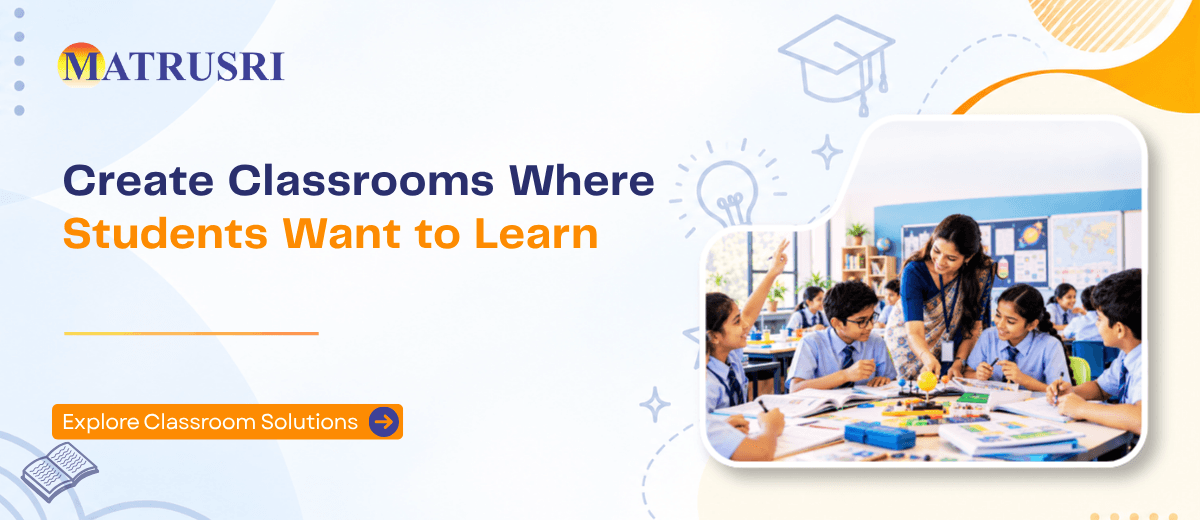
A classroom can have a well-planned lesson, a capable teacher, and excellent learning resources—and still struggle to keep students engaged.
The reason is simple: engagement is not created by content alone. It is created by the learning experience.
Today’s students need opportunities to participate, ask questions, explore ideas, solve problems, discuss concepts, and connect what they learn with the world around them. This does not mean that every classroom needs constant games, technology, or elaborate activities. Effective engagement comes from making students active participants in the learning process.
For schools and teachers, the challenge is therefore not simply to make lessons more entertaining. It is to create engaging classrooms where students understand why learning matters and feel encouraged to participate in it.
What Does Classroom Engagement Really Mean?
Classroom engagement is more than students sitting quietly, completing assignments, or listening to a teacher.
A genuinely engaged student is mentally involved in the learning process. They think about questions, make connections, attempt problems, explain their reasoning, participate in discussions, and respond to feedback.
Engagement can be understood across several dimensions.
Cognitive engagement involves thinking, reasoning, analysing, and solving problems.
Behavioural engagement involves participation, attention, effort, and completing meaningful learning activities.
Emotional engagement involves curiosity, confidence, interest, and a sense of belonging in the classroom.
A strong learning environment considers all three.
Understand Today’s Learners
Students today interact with information in many different ways outside school. They watch videos, explore digital content, communicate online, search for answers, and encounter information from different sources.
This does not mean traditional teaching methods are no longer useful. Direct instruction, explanation, reading, writing, and structured practice remain important.
However, students also benefit when lessons provide opportunities to do something with what they are learning.
A science lesson can involve observation or experimentation. A mathematics lesson can include problem-solving. A language lesson can involve discussion and real-world communication. A social studies lesson can connect concepts with current or historical situations.
The subject does not have to change. The learning experience can.
Connect Lessons to Real-World Contexts
One of the most effective classroom engagement strategies is helping students understand how knowledge connects with real life.
Students are naturally more interested when they can see a reason for learning something.
Instead of presenting a mathematical concept only as a formula, teachers can introduce a practical problem where the concept becomes useful.
Instead of teaching communication skills exclusively through textbook exercises, students can practise conversations, presentations, interviews, or written communication based on realistic situations.
The purpose is not to turn every lesson into a real-world project. Even a short connection between a concept and everyday life can make learning more meaningful.
Ask Better Questions
Questions are among the simplest tools for increasing student participation.
However, not all questions create the same level of engagement.
Questions that require students only to recall a fact may have limited opportunities for discussion. Questions that ask students to explain, compare, predict, justify, or apply an idea encourage deeper thinking.
For example, instead of asking only:
“What is photosynthesis?”
A teacher might ask:
“Why would a plant struggle to survive without sufficient sunlight?”
The second question encourages students to use what they know to explain a situation.
Teachers can also allow students time to think before answering. A short pause after asking a question can give more students the confidence to participate.
Give Students Opportunities to Participate
Student engagement increases when students are not expected to remain passive throughout the lesson.
Participation can take many forms.
Students can discuss a question with a partner, solve a problem in a small group, explain an answer to the class, complete a short activity, analyse an example, or present their reasoning.
Participation should not always mean speaking in front of the entire class. Some students are more comfortable contributing through writing, pair discussions, group activities, or individual responses.
A variety of participation methods gives more learners an opportunity to become involved.
Use Activities With a Clear Learning Purpose
Activities can make classrooms more engaging, but activities alone do not guarantee learning.
Every activity should have a clear academic purpose.
Before introducing an activity, teachers can ask:
What should students understand or be able to do after completing this activity?
If the answer is clear, the activity can be designed around that outcome.
For example, a group activity in mathematics might require students to compare different solution methods. A language activity might involve using new vocabulary in a realistic conversation. A science activity might require students to observe, record, and interpret results.
When activities are connected directly to learning outcomes, engagement and academic value work together.
Balance Individual and Collaborative Learning
Collaboration can be powerful, but students also need opportunities to think independently.
An effective lesson can move between individual thinking, pair work, group discussion, and whole-class interaction.
For example, a teacher can introduce a question, give students a minute to think independently, ask them to discuss their ideas with a partner, and then invite selected students to share their reasoning.
This structure gives students time to develop an answer before being asked to speak publicly.
It also helps teachers understand how students are thinking rather than simply identifying who is willing to raise a hand.
Make Feedback Part of Learning
Feedback should not be limited to marks at the end of an assessment.
Students need to understand what they are doing well, where they are making mistakes, and what they can do differently.
Effective feedback is specific.
Instead of simply saying “wrong,” a teacher can identify the point where the student’s reasoning changed direction and guide them toward reconsidering that step.
Similarly, positive feedback becomes more meaningful when it explains what the student did effectively.
For example, recognising that a student clearly explained their reasoning reinforces the learning behaviour that should continue.
Create a Safe Environment for Questions
Students are unlikely to participate actively if they are afraid of making mistakes.
An engaging classroom should make it acceptable to ask questions, attempt answers, reconsider ideas, and learn from errors.
Teachers can reinforce this by treating mistakes as opportunities for learning rather than reasons for embarrassment.
When students feel comfortable saying, “I don’t understand,” teachers can identify learning gaps earlier.
This is especially important for students who may understand some parts of a lesson but hesitate to seek clarification.
Differentiate Without Complicating the Classroom
Students in the same classroom do not always learn at the same pace.
Some may need additional practice, while others may be ready for more challenging applications.
Teachers can support different learning needs through variations in questioning, practice, examples, grouping, and additional support.
Differentiation does not necessarily require creating completely different lessons for every student.
Small adjustments can make a meaningful difference.
For example, students who need additional support can receive guided examples, while students who are ready for greater challenge can work on application-based problems.
Use Learning Resources Strategically
Well-designed learning resources can support classroom engagement by giving students opportunities to practise, explore, apply, and reinforce concepts.
Textbooks provide structured content, while workbooks and activity-based resources can provide additional opportunities for active practice.
The key is purposeful use.
A resource should support the teacher’s learning objective rather than become an additional burden for students.
Schools can also review whether their learning materials encourage students to think, apply concepts, and engage with questions rather than simply reproduce information.
Technology Can Support Engagement—But It Is Not the Solution
Technology can make certain learning experiences more interactive, but technology alone does not create an engaging classroom.
A digital presentation can still be passive. A classroom without advanced technology can still be highly interactive.
The important question is not:
“Are we using technology?”
It is:
“Is this tool helping students learn better?”
Digital resources can be valuable when they support visualisation, collaboration, practice, research, simulations, or timely feedback.
They should complement effective teaching rather than replace it.
Build Engagement Into the Lesson Structure
A well-structured lesson often provides several opportunities for students to become actively involved.
A simple sequence could be:
Connect → Explain → Explore → Practise → Reflect
The teacher first connects the topic with prior knowledge or a meaningful context.
The concept is then explained clearly.
Students receive an opportunity to explore or apply the idea.
Practice helps reinforce understanding.
Finally, reflection allows students to explain what they learned, identify questions, or consider how they can apply the concept.
This structure can be adapted to different subjects and age groups.
Measure Engagement Through Learning, Not Noise
An active classroom is not necessarily a noisy classroom.
Likewise, a quiet classroom is not necessarily an engaged classroom.
Teachers and school leaders should look for evidence of meaningful learning.
Are students asking relevant questions?
Can they explain concepts?
Are they attempting problems independently?
Can they apply knowledge to new situations?
Are they responding to feedback?
Are students becoming more confident over time?
These indicators provide a better understanding of engagement than simply measuring how much students talk or move around the classroom.
The Teacher Remains the Most Important Element
Learning resources, activities, technology, and classroom design can all support engagement, but the teacher remains central to the learning experience.
An effective teacher understands the students, communicates clearly, asks purposeful questions, adjusts instruction, identifies learning gaps, and creates opportunities for participation.
Teacher development is therefore an important part of creating consistently engaging classrooms.
Schools that invest in continuous professional development can help teachers strengthen not only subject knowledge but also pedagogy, classroom interaction, assessment, and student support.
The Secret Is Meaningful Learning
There is no single activity that will make every classroom engaging.
The real secret is to make learning meaningful, participatory, appropriately challenging, and connected to student thinking.
Students do not need entertainment every minute.
They need to understand what they are learning, why it matters, and how they can actively engage with it.
When teachers combine clear explanations with purposeful questions, meaningful practice, collaboration, feedback, and opportunities for application, engagement becomes part of the learning process rather than an extra activity added to it.
Conclusion
Creating engaging classrooms is not about constantly finding new games or introducing technology.
It starts with a deeper understanding of how students learn.
Teachers can increase engagement by connecting lessons to real-world contexts, asking better questions, providing meaningful opportunities for participation, using purposeful activities, balancing individual and collaborative learning, giving constructive feedback, and creating a safe environment for students to learn from mistakes.
Schools can strengthen this approach further through appropriate learning resources, academic planning, and ongoing teacher development.
Ultimately, the most successful classroom is not the one where students are entertained the most. It is the one where students are thinking, participating, questioning, applying, and growing.
When students become active participants in their own learning, the classroom becomes more than a place where lessons are delivered. It becomes a place where meaningful learning happens.