Absolutely. For this topic, a story-driven, paragraph-based blog will be much stronger than a blog filled with bullet points. Here is a cleaner, more natural version designed for SEO, readability, and school decision-makers.
Why Schools Need Long-Term Academic Partners Instead of Book Vendors
Focus Keyword: long-term academic partner for schools
A school’s academic journey does not begin when a box of books arrives—and it certainly does not end when those books are distributed to students.
Yet, for many schools, the relationship with an education provider still follows a simple cycle: select the books, place the order, receive the materials, and start the academic year.
But education today demands much more.
Schools are expected to create meaningful learning experiences, support teachers, strengthen classroom engagement, implement curriculum effectively, monitor student progress and continuously improve academic outcomes. In this environment, simply supplying books is no longer enough.
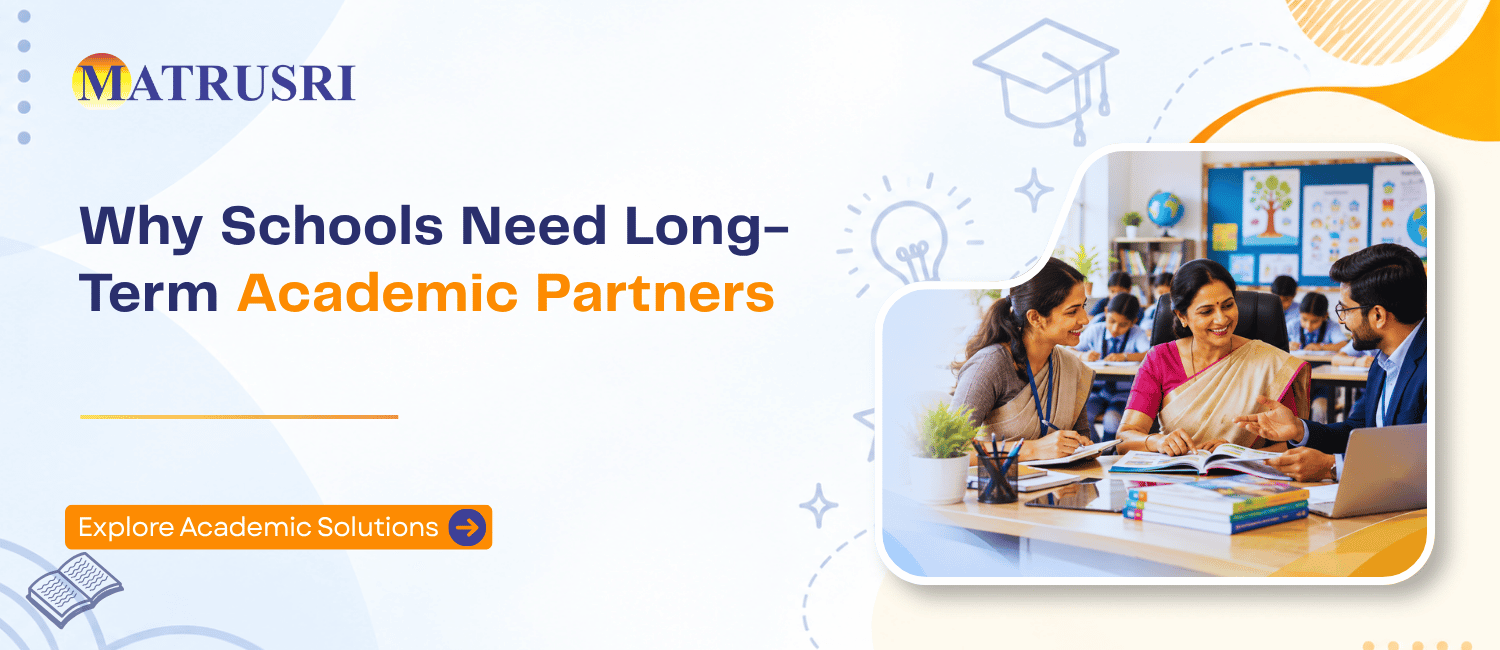
Schools need a long-term academic partner for schools—a partner that understands the complete learning journey and stays connected beyond the point of delivery.
A Book Vendor Delivers. An Academic Partner Stays Connected.
Imagine a school preparing for a new academic year. The textbooks and workbooks have been selected, the order has been placed, and everything arrives on time. On paper, the process is complete.
But once classrooms become active, new questions emerge.
Are teachers comfortable implementing the curriculum? Are students understanding concepts rather than simply memorising them? Are the learning resources being used effectively? Do teachers need support with classroom strategies? How can student progress be communicated more meaningfully to parents?
These questions cannot be answered by a delivery receipt.
They require an ongoing relationship between the school and its education partner.
That is the fundamental difference between a book vendor and a long-term academic partner.
Education Is More Than a Book
Books play an important role in structured learning. They provide content, sequence, practice and reference material for teachers and students.
However, the effectiveness of any learning resource depends largely on how it is implemented.
A well-designed resource becomes more valuable when teachers understand how to use it effectively, students are encouraged to engage with concepts, and schools have the right academic support around it.
This is why schools should look beyond the question, “Which books should we choose?”
The more important question is:
“Who will support us in making learning better?”
The Classroom Is Where the Real Work Begins
Once a book reaches the classroom, its real journey begins.
A teacher may need to introduce a difficult concept in a simpler way. Students may need additional practice. A particular topic may require a more engaging activity. School leaders may identify an area where teachers need additional support.
These situations are part of everyday education.
A long-term academic partner can understand these challenges and work with the school to address them. Instead of treating the book as the final product, the focus shifts towards how the resource contributes to the overall teaching and learning experience.
This creates a more meaningful connection between curriculum, teachers, resources and students.
Teachers Need Continuous Support
Teachers are at the heart of every successful school.
Even when a curriculum and learning resources are carefully planned, classroom outcomes ultimately depend on how effectively teachers deliver them.
Modern classrooms require teachers to continuously develop their teaching approaches. They may need support with student engagement, concept-based teaching, assessment practices, technology integration or new educational approaches.
This is where an academic partnership becomes valuable.
Instead of providing a one-time training session and moving on, a long-term partner can understand the school’s requirements, provide relevant training and support implementation over time.
The objective is not simply to train teachers.
It is to help them become more confident, effective and adaptable educators.
Every School Has a Different Story
There is no single academic model that works exactly the same way for every school.
One school may be focused on improving foundational learning. Another may want to strengthen high-school academic performance. Another may be looking for better teacher development or stronger parent communication.
A long-term academic relationship allows the partner to understand these differences.
As the relationship develops, the partner becomes familiar with the school’s academic priorities, challenges and expectations. This understanding can make future recommendations more relevant and practical.
Instead of starting the conversation from scratch every academic year, schools can build on what they have already learned.
Academic Improvement Is a Continuous Journey
Real academic improvement rarely happens through one initiative.
It develops through a continuous cycle of planning, teaching, practice, assessment, feedback and improvement.
A school may introduce a new learning resource today, provide teacher training tomorrow and review classroom implementation later. Each stage contributes to the larger academic picture.
A long-term academic partner can support this journey by staying involved and helping schools connect these different activities.
This is what transforms individual services into a complete school solution.
Beyond Marks: Understanding Student Progress
Another important part of the academic journey is understanding student progress.
A report card should not simply tell parents whether a student scored 70 or 80 percent. It should contribute to a broader understanding of the student’s academic development.
When schools have structured academic processes and meaningful communication, conversations between teachers and parents can become more useful.
Instead of focusing only on marks, the discussion can move towards understanding strengths, identifying areas that need attention and supporting the student’s next stage of learning.
A long-term academic partner can contribute to this broader approach by supporting schools with relevant academic resources and processes.
One School, One Connected Academic Approach
When schools work with multiple providers for different academic requirements, coordination can become challenging.
One provider supplies books. Another conducts teacher training. Someone else handles academic support. Another system may be used for assessment or reporting.
Each service may have value, but the school is left managing the connections between them.
A comprehensive academic partner can help simplify this process by bringing relevant academic solutions together.
The objective is not to replace every specialist provider. It is to create a more connected approach where the school’s academic requirements are understood as part of one larger ecosystem.
What Should Schools Expect From an Academic Partner?
The right academic partner should be willing to understand the school before recommending a solution.
The conversation should go beyond products and pricing.
It should include questions about the school’s curriculum, teachers, students, academic goals and areas where additional support may be required.
Most importantly, the relationship should continue after implementation.
Because the true value of an education partner is not measured only by what is delivered.
It is measured by how effectively that support contributes to the school’s academic journey.
From Transaction to Partnership
The difference between a vendor and a partner can be summed up simply.
A vendor asks:
“What do you want to order?”
A long-term academic partner asks:
“What does your school need to achieve?”
That shift changes everything.
It moves the conversation from books to learning, from transactions to relationships and from yearly procurement to continuous academic development.
For schools, this can create a stronger foundation for long-term improvement.
Why Matrusri Takes a Different Approach
Matrusri believes that schools need more than educational resources alone.
As A Complete School Solution, Matrusri brings together learning resources and school-focused academic support designed to help schools strengthen teaching and learning.
From Pre-Primary and Primary Education to High School Education, IIT Excel, Speak Easy English and Teacher Training, the focus is on supporting different stages and needs of the school’s academic journey.
The objective is simple: to build a long-term relationship with schools and support better learning experiences—not simply deliver books.
The Future of School Partnerships Is About More Than Products
Education is a long-term journey.
Books are part of that journey. Teachers are part of it. Students, parents, curriculum, assessment and academic planning are part of it too.
When all these elements work together, schools can create a stronger and more connected learning environment.
That is why the right long-term academic partner for schools should not simply ask what needs to be delivered.