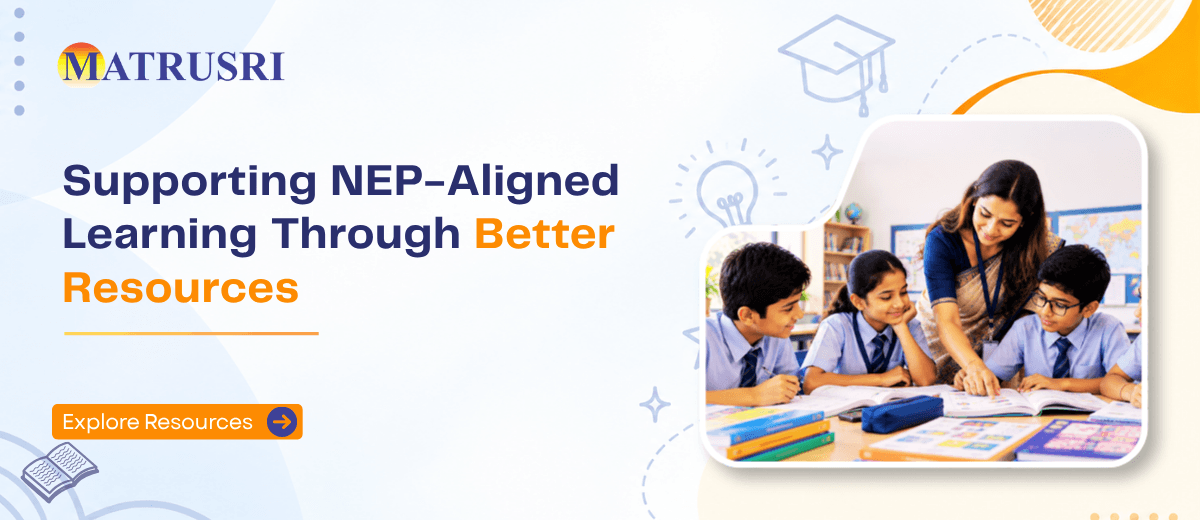
The way students learn is changing.
Modern school education is moving beyond simply completing chapters and memorising information. Schools increasingly need learning experiences that help students understand concepts, apply knowledge, develop competencies, think critically, and connect classroom learning with real-world situations.
The National Education Policy (NEP) 2020 reflects this broader vision for Indian education. It places emphasis on conceptual understanding, competency development, experiential learning, critical thinking, holistic development, and reducing an excessive focus on rote learning.
For schools, this raises an important question:
How can learning resources support these objectives in everyday classroom teaching?
Books remain an important part of the school learning ecosystem. However, their role can go beyond delivering syllabus content. Well-designed learning resources can help teachers introduce concepts, provide structured practice, reinforce understanding, encourage application, and support students throughout the learning process.
This is where NEP aligned books can become valuable academic resources.
Matrusri books are designed to support structured learning experiences that can complement schools’ efforts toward concept-based, competency-oriented, and engaging education.
Understanding the Role of Books in NEP-Aligned Learning
NEP 2020 is not simply about changing the books students use.
The broader transformation involves curriculum, pedagogy, assessment, teacher development, learning outcomes, and the overall educational environment.
Therefore, a book should not be considered “NEP-aligned” simply because it contains the prescribed syllabus.
A more meaningful approach is to examine how learning material supports the educational objectives schools are trying to achieve.
A useful learning resource can help students:
- Understand concepts clearly
- Connect ideas across topics
- Apply knowledge
- Practise skills
- Develop reasoning
- Engage with meaningful activities
- Reflect on their learning
- Strengthen foundational and subject-specific competencies
When books work together with effective teaching and assessment, they can become an important part of a school’s academic ecosystem.
1. Moving Beyond Rote Learning
One of the important shifts in modern education is moving from memorisation toward understanding.
Memorisation has its place in learning. Students need to remember vocabulary, facts, definitions, formulas, terminology, and other foundational knowledge.
The challenge arises when remembering information becomes the primary measure of learning.
Concept-focused learning encourages students to understand why something works, how ideas are connected, and where knowledge can be applied.
Matrusri books can support this approach by presenting learning in a structured way that encourages students to engage with concepts rather than simply reproduce information.
For schools, this creates an opportunity to use books as a starting point for classroom discussion, questioning, activities, practice, and application.
2. Supporting Conceptual Understanding
Strong learning begins with strong concepts.
When students understand the underlying idea behind a topic, they are better positioned to apply that knowledge in unfamiliar situations.
For example, mathematics learning should not stop at remembering a formula. Students should understand the relationship represented by the formula and know when and how to use it.
Similarly, science learning can move beyond definitions by encouraging students to understand processes, relationships, observations, and applications.
Matrusri books can support schools by providing structured opportunities to introduce, explain, reinforce, and practise concepts.
This makes the learning journey more systematic for both teachers and students.
3. Encouraging Competency-Based Learning
Competency-based learning focuses on what students can understand and do with their knowledge.
This is an important distinction.
A student may be able to reproduce an answer but still struggle to apply the concept to a new situation. Competency-oriented learning aims to develop the ability to use knowledge meaningfully.
Learning resources can support this through questions and activities that encourage students to:
- Apply concepts
- Analyse information
- Solve problems
- Interpret situations
- Explain their reasoning
- Make connections
- Communicate ideas
The exact activities will naturally differ according to the subject and grade level.
The broader objective remains the same: helping students move from knowing to understanding and applying.
4. Connecting Learning With Practice
Understanding a concept is only one part of the learning process.
Students need opportunities to practise what they have learned.
This is particularly important when developing skills that improve through repeated application.
Structured practice can help students recognise mistakes, strengthen understanding, build confidence, and gradually become more independent learners.
Matrusri learning resources can complement classroom teaching by providing opportunities for guided and independent practice.
The emphasis should not be on completing the largest possible number of exercises.
Instead, practice should be purposeful and connected to the intended learning outcome.
5. Supporting Experiential Learning
Experiential learning encourages students to learn through doing, observing, exploring, discussing, and applying.
A book cannot replace real classroom experiences, experiments, projects, field activities, or teacher-led discussions.
However, learning resources can help teachers prepare students for these experiences and reinforce what happens during them.
For example, a lesson can introduce a concept through a learning resource, move into a classroom activity, and then return to structured practice that helps students reflect on what they observed.
This creates a connection between content, experience, and application.
That connection can make learning more meaningful.
6. Helping Teachers Deliver Structured Learning
A strong learning resource should support teachers rather than compete with them.
Teachers remain central to the learning process. They understand their students, adapt explanations, ask questions, provide feedback, and respond to individual learning needs.
Books can provide the structure around which these teaching experiences are organised.
A thoughtfully structured resource can help teachers move through concepts in a logical sequence while giving students opportunities to practise and reinforce learning.
This can be particularly valuable when schools are working toward greater consistency in curriculum delivery across classrooms.
7. Reinforcing Learning Through Structured Practice
Students do not always retain everything they learn during the first classroom interaction.
Regular reinforcement helps strengthen learning.
Practice questions, activities, revision exercises, examples, and application tasks can provide multiple opportunities for students to revisit important concepts.
This is where learning resources become more than content repositories.
They become tools for learning reinforcement.
For schools, structured resources can also make it easier to identify topics where students need additional explanation or practice.
8. Supporting Different Learning Needs
Every classroom includes students with different levels of prior knowledge, confidence, learning pace, and academic needs.
A single teaching approach may not work equally well for every learner.
Learning resources can help teachers provide additional practice for students who need reinforcement while allowing other students to engage with more challenging applications.
Visual explanations, examples, activities, structured questions, and varied forms of practice can provide additional entry points into a topic.
The teacher’s judgement remains essential, but well-designed resources can provide useful flexibility.
9. Connecting Learning With Assessment
Teaching, learning, and assessment should not operate as completely separate processes.
Assessment should provide information about what students understand and where they need support.
Learning resources can contribute by giving students regular opportunities to practise and demonstrate their understanding.
When questions move beyond simple recall and include application, reasoning, interpretation, and problem-solving, teachers can gain a better view of student learning.
This also helps students become familiar with using their knowledge rather than simply remembering answers.
10. Supporting Holistic Academic Development
NEP 2020 presents a broader vision of education that extends beyond examination performance.
Schools increasingly need to consider skills such as communication, critical thinking, creativity, collaboration, problem-solving, and independent learning alongside subject knowledge.
Learning resources can contribute to this broader development when they provide opportunities for students to think, communicate, analyse, apply, and reflect.
The extent to which a particular resource supports these objectives depends on its design and how teachers use it in the classroom.
This is why the book should be viewed as one component of the larger academic ecosystem, rather than the complete learning experience by itself.
Choosing NEP-Aligned Books for Your School
Schools evaluating learning resources should look beyond labels.
Instead of asking only whether a book claims to be NEP-aligned, academic leaders can examine how the resource actually supports learning.
Consider questions such as:
Does it encourage conceptual understanding?
Does it provide opportunities for application?
Does it support competency development?
Does it include meaningful practice?
Does it complement classroom teaching?
Does it help teachers identify areas requiring reinforcement?
Does it support the school’s curriculum and learning outcomes?
Does its structure make learning manageable for students and teachers?
These questions can help schools make more informed decisions.
The Importance of School-Specific Implementation
No book can independently deliver NEP 2020.
Successful implementation depends on how the entire school ecosystem works together.
Curriculum planning, teacher development, classroom pedagogy, assessment, learning resources, academic monitoring, and school leadership all have important roles.
Matrusri books should therefore be viewed as learning resources that can support schools in implementing an academic approach aligned with contemporary educational priorities.
The effectiveness of any resource ultimately depends on how it is integrated into teaching and learning.
Building a Stronger Learning Ecosystem
A successful school does not rely on one resource or one teaching method.
Instead, it creates an ecosystem where different elements support one another.
Teachers provide instruction and guidance.
Learning resources provide structure and opportunities for practice.
Assessment provides evidence of learning.
Academic planning creates consistency.
School leadership provides direction.
Students actively participate in the learning process.
When these elements work together, schools are better positioned to create meaningful learning experiences.
This is the context in which NEP aligned books can provide genuine value.
Conclusion
NEP 2020 encourages schools to think beyond rote learning and focus more strongly on conceptual understanding, competency development, experiential learning, critical thinking, and holistic student development.
Books remain an important part of this journey, but their value depends on how effectively they support these broader learning objectives.
Matrusri books are designed to complement school education through structured content, concept development, practice, application, and learning reinforcement.
For schools, the objective should not simply be to select books labelled as NEP-aligned. The more important question is whether the resources genuinely support the school’s curriculum, teaching practices, learning outcomes, and student needs.
When thoughtfully designed books are combined with capable teachers, purposeful academic planning, meaningful assessment, and active classroom learning, they can become a valuable part of a NEP-aligned learning ecosystem.
The future of school education is not about replacing one resource with another. It is about bringing curriculum, teachers, students, assessment, and learning resources together to create better educational experiences.