Understanding NEP 2020: What Every School Must Know
NEP 2020 is more than an education policy. It is a call to rethink how students learn, how teachers teach, and how schools prepare children for the future.
For school leaders, the important question is no longer simply “What does NEP 2020 say?” The more meaningful question is: “How can we turn its vision into everyday classroom practice?”
India’s National Education Policy 2020 envisions an education system that develops knowledge, skills, values, creativity, critical thinking, and responsible citizenship. It also proposes a new 5+3+3+4 curricular and pedagogical structure covering ages 3 to 18.
For schools, this represents a significant shift—from education focused primarily on content and examinations toward learning that is more competency-based, experiential, flexible, holistic, and student-centred.
What Does NEP 2020 Mean for Schools?
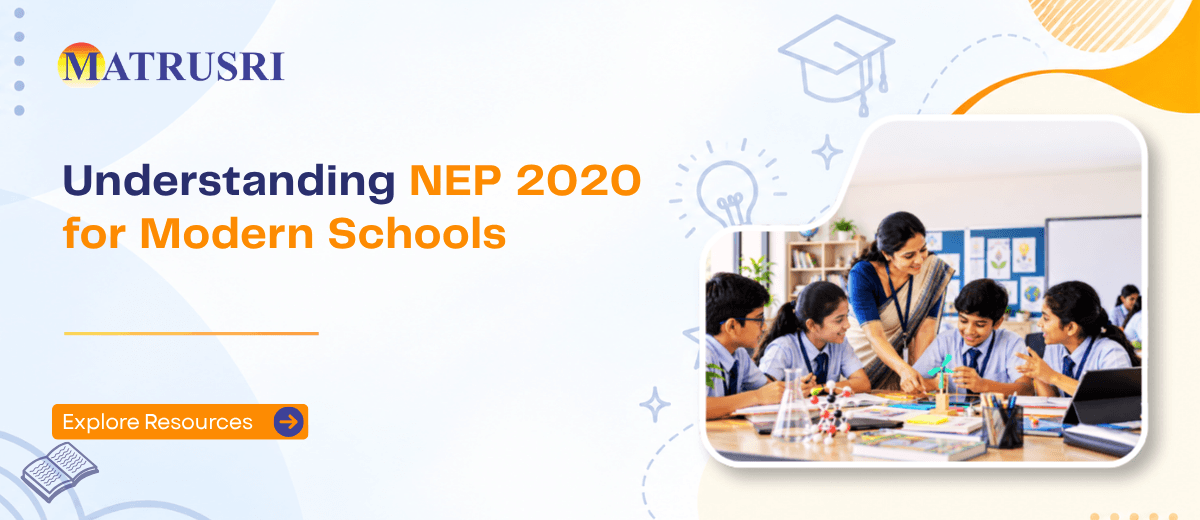
Imagine a classroom where students are not simply memorising a science concept for an examination.
Instead, they conduct an experiment, discuss what they observe, ask questions, connect the concept to everyday life, and explain their understanding in their own words.
That is the kind of learning NEP 2020 seeks to encourage.
The policy emphasises reducing the emphasis on rote learning and strengthening conceptual understanding, critical thinking, creativity, experiential learning, and holistic development.
This means schools need to look beyond the textbook and consider the complete learning experience.
1. Move from Rote Learning to Conceptual Understanding
Students may remember an answer for an examination, but true learning happens when they understand why something works and how it can be applied.
NEP 2020 encourages schools to focus on conceptual clarity and competency development rather than simply completing a syllabus.
Teachers can make this shift through:
- Real-life examples
- Classroom discussions
- Problem-solving activities
- Experiments and demonstrations
- Projects and collaborative learning
- Questions that encourage reasoning
The goal is simple: help students understand, apply, and explain—not just remember.
2. Make Learning Experiential
Learning becomes more meaningful when students actively participate.
Activity-based learning, projects, experiments, field experiences, storytelling, art integration, and practical demonstrations can help students connect classroom concepts with the world around them.
CBSE has also highlighted experiential and active learning as effective approaches for competency-based education.
For schools, this means creating classrooms where students have opportunities to explore, question, create, collaborate, and learn by doing.
3. Strengthen Teacher Development
No education policy can succeed without empowered teachers.
Teachers are responsible for translating educational goals into meaningful classroom experiences. They need ongoing professional development, practical resources, collaborative opportunities, and support to adopt new teaching approaches.
CBSE has specifically recognised the importance of building the capacity of teachers and principals for effective implementation of school-based reforms.
Schools should therefore treat teacher development as a continuous academic process—not a one-time training activity.
4. Rethink Assessment
One of the most important changes is the shift from simply testing what students remember to understanding what students can do with what they have learned.
Competency-based assessment looks at knowledge, skills, values, and the ability to apply learning in appropriate real-life situations.
Schools can strengthen this approach through:
- Application-based questions
- Projects
- Case studies
- Competency-based worksheets
- Classroom observations
- Formative assessments
- Learning-gap analysis
Assessment should become a tool that improves learning, not simply records marks.
5. Focus on Holistic Development
A student’s development cannot be measured through academic marks alone.
NEP 2020 places emphasis on the holistic development of learners, including cognitive, social, emotional, physical, creative, and ethical dimensions.
The policy also encourages greater flexibility and integration across areas such as arts, sports, vocational education, sciences, and humanities, particularly at the secondary level.
Schools can support this vision by creating opportunities for students to develop communication, collaboration, creativity, problem-solving, confidence, and life skills alongside academic knowledge.
6. Use Technology as a Learning Enabler
Technology can make learning more accessible, visual, interactive, and personalised.
Digital resources, educational videos, simulations, interactive content, and technology-supported classrooms can help students revisit difficult concepts and learn at their own pace.
However, technology should support teachers—not replace them.
The strongest model is one where technology and effective teaching work together to create better learning experiences.
7. Build Stronger School–Parent Partnerships
NEP 2020’s vision ultimately depends on a learning ecosystem that extends beyond the classroom.
Parents play an important role in supporting children’s learning, confidence, wellbeing, and development.
Regular communication, academic guidance, parent orientation programmes, and meaningful progress updates can help schools and families work together more effectively.
When teachers, parents, and school leaders share a common understanding of a child’s learning journey, students receive stronger and more consistent support.
The Future-Ready School
A future-ready school does not adopt NEP 2020 simply because it is a policy requirement.
It embraces the underlying idea that education should prepare students not only for examinations, but for life.
This requires strong curriculum planning, empowered teachers, meaningful assessment, experiential learning, technology integration, skill development, and continuous academic support.
Government initiatives such as PM SHRI also emphasise showcasing NEP 2020 through school practices, exposure to 21st-century skills, learning-progress tracking, inclusive practices, and quality learning environments.
The journey will look different for every school. What matters is having a clear vision, capable teachers, appropriate resources, and a commitment to continuous improvement.
Final Thoughts
NEP 2020 is not simply about changing what schools teach. It is about changing how students experience learning.
The most successful schools will be those that move beyond policy documents and bring the principles of NEP 2020 into everyday classrooms.
When teachers are empowered, assessments become meaningful, technology supports learning, students actively participate, and parents become partners, the vision of a more holistic and future-ready education system becomes much more achievable.
The question for every school is therefore not just:
“Are we following NEP 2020?”
It is:
“Can our students experience NEP 2020 in the classroom every day?”
That is where meaningful educational transformation begins.
MatruSri Education believes schools need more than educational resources—they need the right academic support to turn educational vision into meaningful classroom practice.